Alpha · invite only

Know what your groceries actually cost.

Photograph a receipt. Every line item is read off it — then the hard part: the cryptic text a register prints is resolved into real products, so the same item bought at three stores under three names becomes one thing you can actually compare.

Already have an account? Sign in

Swipe through
The problem

A receipt is a terrible record of what you bought.

It prints GV SHRP CHDR 8Z and a total. Not the price per ounce, not whether that was a sale, not what the same cheese cost at the other store last month.

So the one question worth asking — is this actually a good price? — is unanswerable.

What the register printedWhat it actually is
GV SHRP CHDR 8Z
Sharp Cheddar Cheese, BlockGreat Value · 8 oz · $0.44/oz
ORG BNLS CHKN BRST
Chicken Breast, Boneless — OrganicPoultry · per lb
1LT HRD SLTZR LMN
Hard Seltzer, LemonBeverages · 1 L
Step one · the only manual bit

Photograph it. Claude reads the rest.

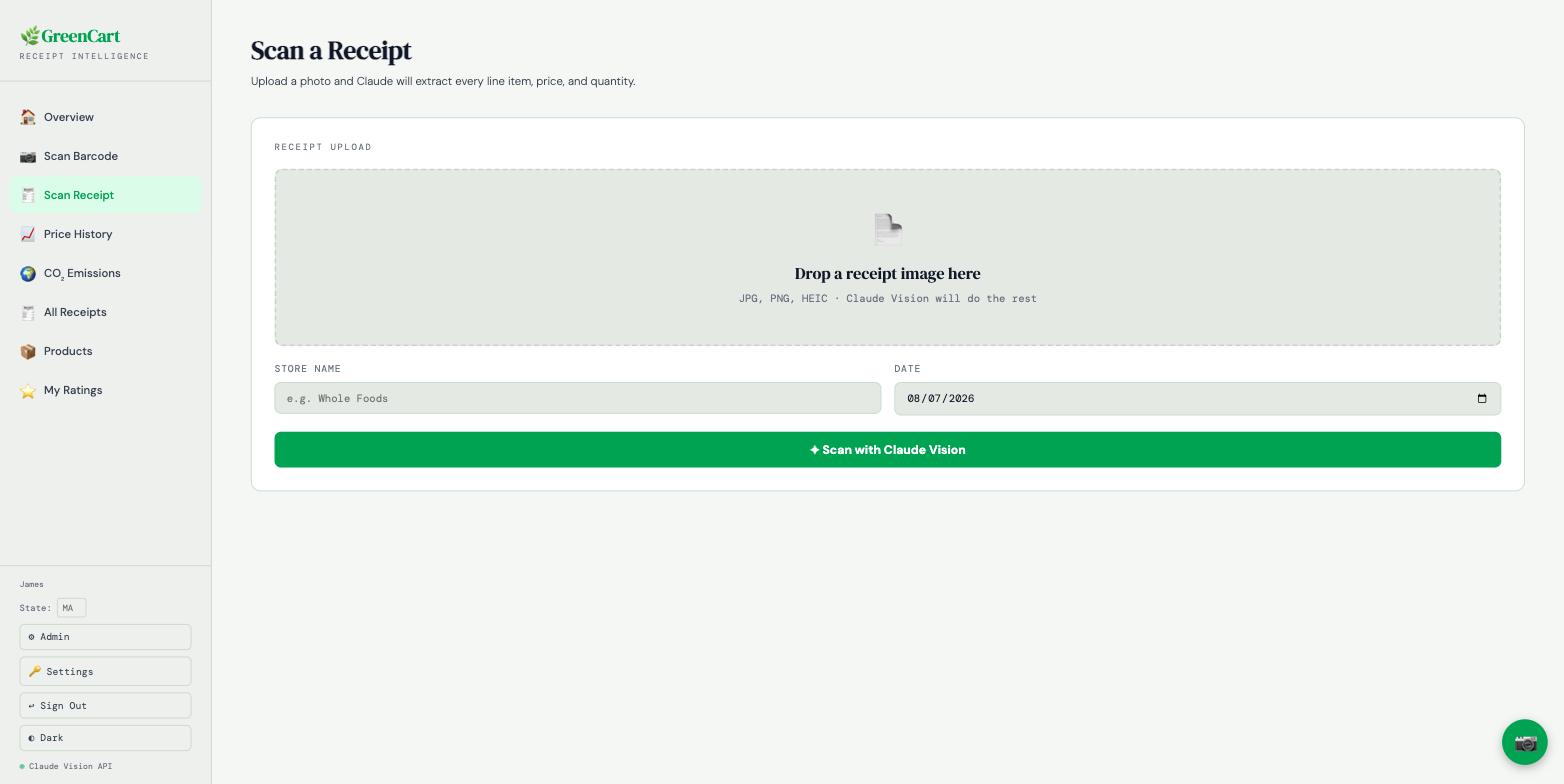
Drop in a photo — JPG, PNG or HEIC. Claude Vision pulls out every line item, its price and its quantity, including the abbreviations, the deposits and the discounts.

You bring your own Claude account. The scanning runs on Anthropic's API and somebody has to pay for the inference — so an invite comes with the assumption that it's yours.

If you'd rather not wire up an API key, there are two other routes in: drive it from Claude Code with our import skill, or do it by hand through claude.ai and paste the result. Same pipeline, more elbow grease.

The Scan a Receipt screen: a drop area reading 'Drop a receipt image here', fields for store name and date, and a Scan with Claude Vision button.
Drop the photo, confirm the store and date, and the line items come back extracted.
Step two · the hard part

It stops being receipts and becomes a catalog.

Every line is resolved to a real product, and every product carries what it actually is: its class, its brand, the company behind the brand, whether it's organic, what the company has certified.

That is the work. Extraction is the easy half — turning a pile of abbreviations into something trustworthy enough to compare is where the effort goes, and it is why the alpha asks for help.

◆ What a resolved product carries
Chicken Breast, Boneless
OrganicPoultryB Corp
$7.99/lb
Chicken Breast, Boneless
PoultryStore brand
$4.49/lb
Same class, both stores
Comparable at last
+$3.50the organic premium
What you get

Price history that compares like with like.

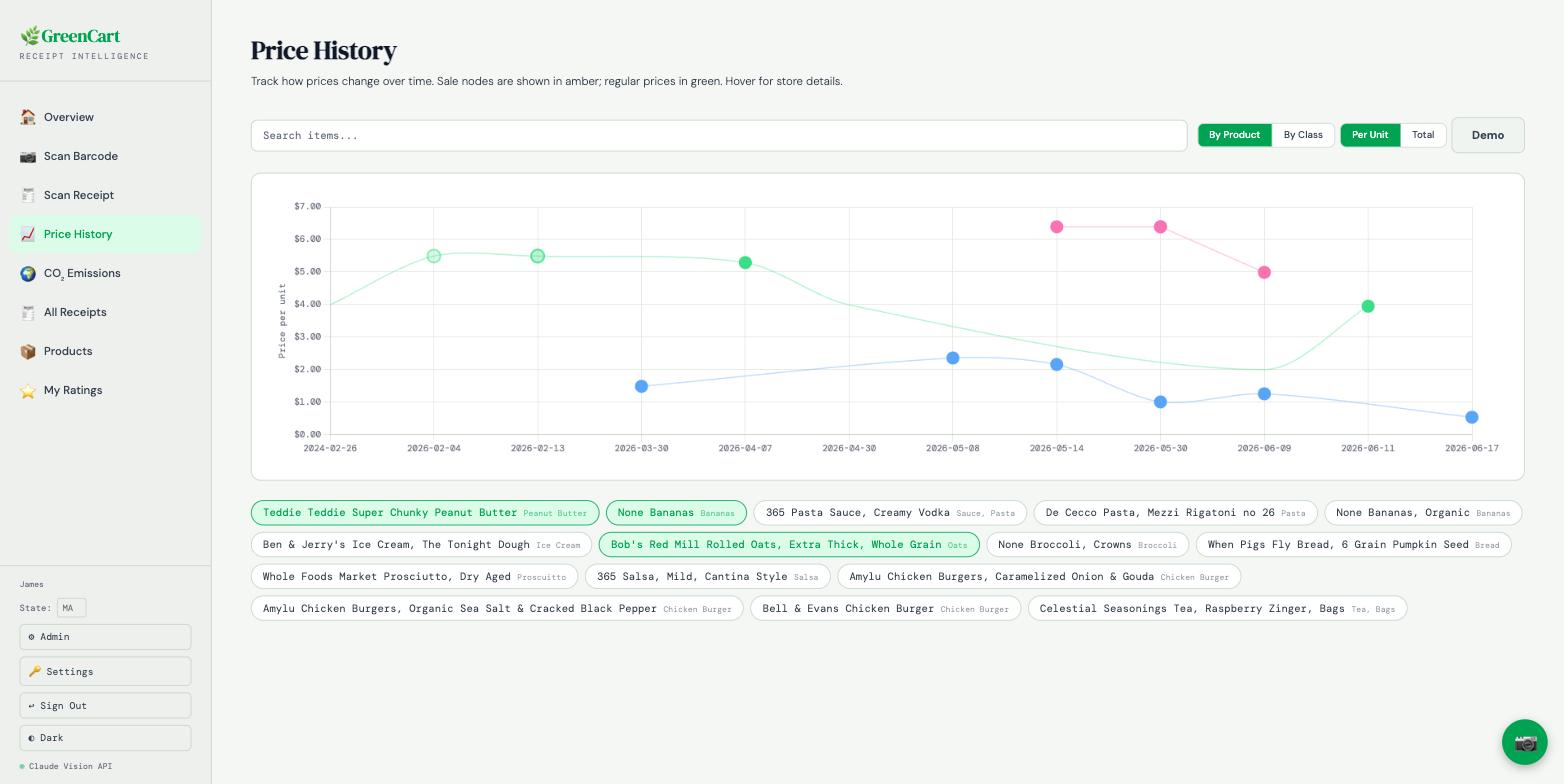
Per unit rather than per package, across every store you shop, by product or by product class — so a 12 oz jar and an 18 oz jar of the same thing land on the same line.

A sale price is marked as a sale rather than quietly dragging the average down. Knowing the regular price and the sale price as two different facts is the whole point.

The Price History screen: a line chart of price per unit over time for several products, with sale prices ringed and regular prices solid, above a row of selectable product chips.
Sale nodes ringed, regular prices solid. Shown with the app's built-in demo data.
What you get

What the packaging is, and where it goes after.

Products carry their packaging broken down by component — the tub, the film, the sleeve — each with its material, whether it takes curbside recycling or needs a drop-off, and how much recycled content it already contains.

This works today. It's the part of the sustainability picture that doesn't need a model or an estimate — it's a fact about the object, so it's the part we built first.

◆ A resolved product's packaging
Tub — Polypropylene (#5)
Curbside30% recycled
Lid film — Multilayer
Drop-off only
Sleeve — Paperboard
Curbside100% recycled
Next up · in build

A verdict while you're still holding it.

Scan the barcode in the aisle and get an answer before it goes in the cart: is this actually a good price against everywhere you've bought it — and does it match what you said you cared about?

This is the point of all the catalog work. Price history is worth most at the moment of the decision, not in a report you read on Sunday.

Good price$0.44/oz — lowest you've paid in 6 months
! Not organicYou said organic dairy matters to you
Best price seen$0.44/oz · here
Usual price$0.58/oz
Organic option+$1.20 · aisle 4
Next up · in design

You bought this. You could have bought that.

Once every product is resolved to a class, the app can look sideways: a different brand, at a store you already shop, cheaper per unit — and meeting the same standards you set.

Not a generic recommendation engine. It only suggests what clears your own bar, which is the difference between advice you'd take and advertising.

◆ Suggested swap
What you bought
Store brandPasta Sauce
$0.21/oz
Same class, better fit
OrganicB CorpPasta Sauce
$0.19/ozat a store you shop
Meets your standards3 of 3
Cost difference−$0.02/oz
Next up · in design

Your values, measured. Not ours.

Buy organic. Avoid private-equity-owned brands. Favour locally owned. Keep the carbon down. You declare what you care about and the app measures you against it — rather than deciding for you what a good grocery is.

The emissions reporting is built but not yet populated, and the goal-setting on top of it is still being designed. Both are things an alpha member gets to shape, which is most of why the alpha exists.

Organic where it matters61%
Locally owned brands18%
Avoided private-equity owned74%
Estimated CO₂e this month— not yet live

Ownership chains and certifications are already in the catalog. Unknown will always render as unknown — a score that quietly treats missing data as a pass is worse than no score.

Request an invite

Come in early, and help build the standard.

Accounts are handed out by hand. If you'd like one, tell us who you are — and know what we'll ask of you in return:

  • Tell us when it's wrong — and then fix it. Not just report it. We're a small team, and the catalog is only worth anything if it's accurate, so we need people who care deeply about data quality and will get their hands into it.
  • Help label products. Turning receipt text into a catalog you'd trust takes human judgment — confirming products, brands, packaging and classes against a shared standard. Everyone's shopping gets better for it.
  • Bring your own Claude account. Scanning runs on Anthropic's API and the inference is yours to pay for. Or use Claude Code with our import skill instead.
  • Scan the receipt instead of binning it. We're not going to pretend this is less effort than throwing it away — it never will be. The bar we're aiming at is that it's worth doing anyway. If it isn't, tell us why.

We use your email to reply to you and nothing else. No list, no sharing, and you can ask us to delete the request at any time. Replies are written by hand, so give us a few days.